AI Won't Just Change Jobs. It Could Change the Very Structure of Companies.
What if the biggest opportunity of AI wasn't replacing employees, but fundamentally rethinking how people work together?
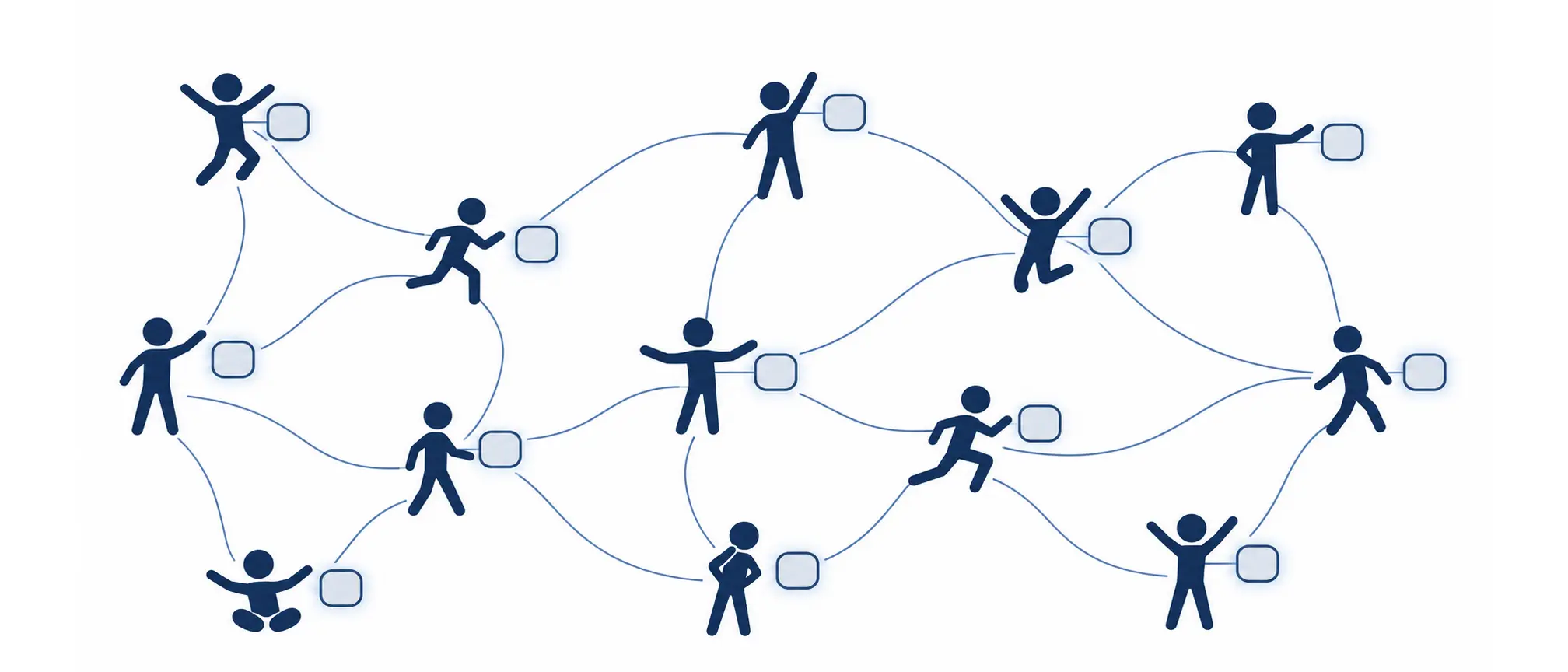
Whenever we discuss the impact of artificial intelligence on companies, the conversation quickly turns toward productivity and employment. If one person, supported by AI agents, can accomplish what previously required five people, the economic conclusion seems obvious: companies could operate with fewer employees, reducing costs and increasing profitability.
And perhaps that's exactly what some companies will do. But I believe we're overlooking a much more interesting opportunity. What if, instead of reducing the workforce, we used this increase in productivity to fundamentally rethink how organizations operate? What if we could preserve their most valuable assets—their people, relationships, and collective knowledge—while giving them unprecedented autonomy to create value?
This is the hypothesis I'd like to explore: AI might not only transform individual jobs. It could challenge the very reasons we organize people into fixed teams, departments, and specialized functions.
A Company Is More Than the Sum of Its Employees

When evaluating a company's capabilities, we tend to focus on individual expertise. We count developers, Product Managers, designers, salespeople, and other specialists. We measure their productivity, their cost, and their contribution to the organization's objectives.
But I believe this perspective misses something fundamental. A company is not simply a collection of individuals performing isolated tasks. It is a collective, built around relationships, shared experience, trust, and the capacity to collaborate.
A developer doesn't bring value exclusively through their ability to write code. They also understand the company's history, its customers, its constraints, and the people they work with. The same applies to a Product Manager, a salesperson, or an architect. Much of their value emerges from their interactions with others, not just their individual expertise.
This intuition has some support in organizational research. In their 1998 paper, Social Capital, Intellectual Capital, and the Organizational Advantage, Janine Nahapiet and Sumantra Ghoshal explored how relationships and social capital facilitate the creation and exchange of knowledge. Their argument suggests that organizations can develop advantages that cannot easily be replicated by assembling the same individuals independently.
Similarly, research published in Science in 2010 identified a collective intelligence factor associated with group performance across different tasks. Interestingly, group effectiveness was not simply explained by the intelligence of its most capable members. Social sensitivity and patterns of participation also mattered.
Of course, this doesn't mean teams always outperform individuals. Collaboration introduces coordination costs, communication overhead, and sometimes unnecessary complexity. And AI is making the comparison even more interesting.
A field experiment conducted at Procter & Gamble, published in Organization Science in 2026, found that individuals supported by generative AI could achieve results comparable to two-person teams without AI on specific product innovation challenges. AI also helped participants produce solutions that crossed traditional functional boundaries.
That is a significant finding. It suggests that some benefits of combining different expert perspectives can now be reproduced, at least partially, through AI.
But does that mean human collaboration has become obsolete? I don't think we can draw that conclusion. A short product innovation exercise is not equivalent to building a business, developing long-term relationships with customers, or navigating years of organizational change.
My hypothesis is that AI makes individuals more capable, but that doesn't necessarily make the collective less valuable. It changes what people need from one another.
Keep the People, Not Necessarily the Teams
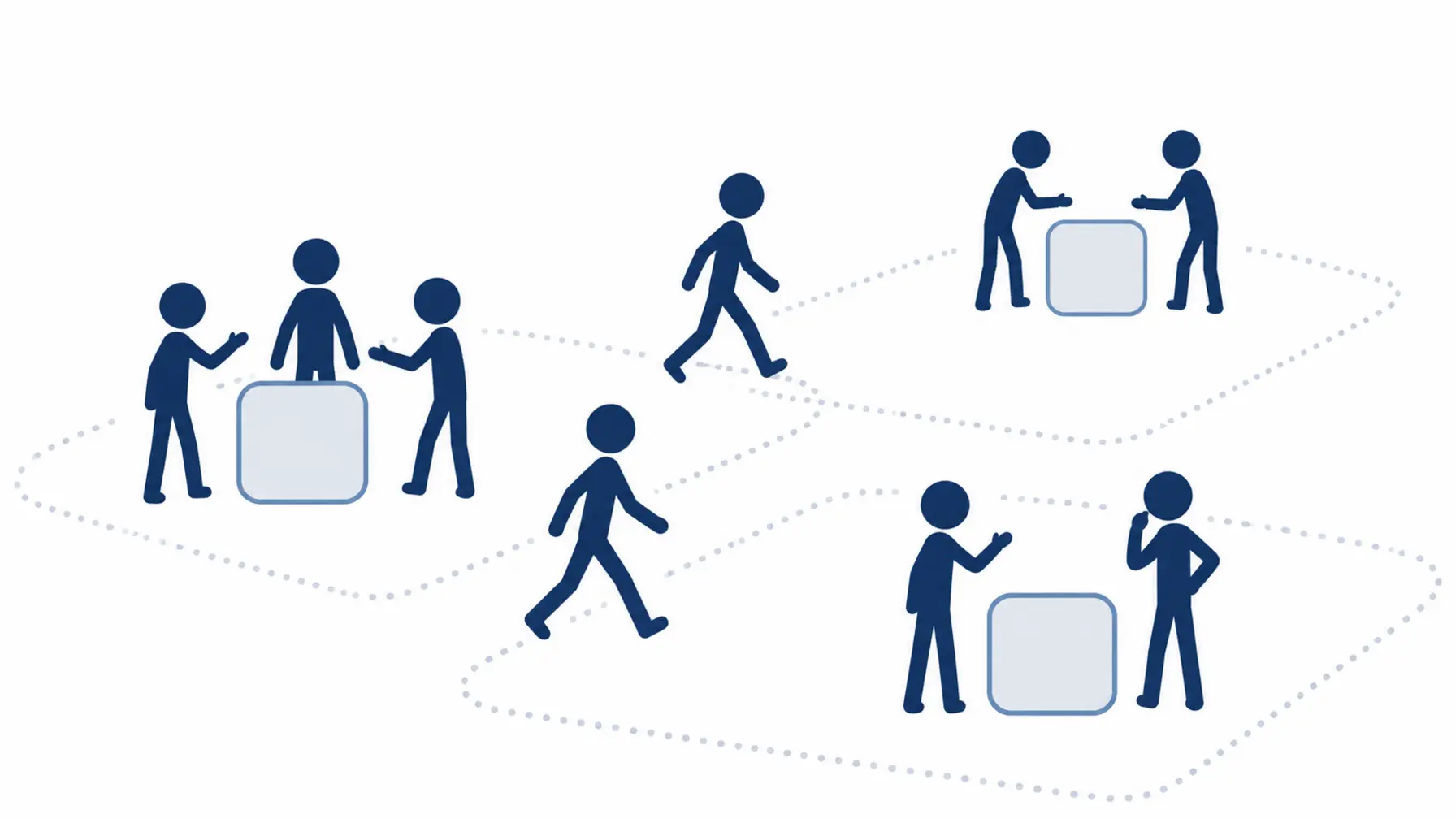
Today, most companies organize people according to their expertise and responsibilities. We have IT departments, business departments, marketing teams, product teams, and management structures. Even when we adopt Agile methodologies and create cross-functional teams, those teams frequently remain relatively stable structures with predefined roles.
There are good reasons for this. Specialized teams make expertise accessible, clarify responsibilities, and allow people to develop effective working relationships over time.
But what happens when AI dramatically reduces the technical barriers between these disciplines?
Imagine a developer who can orchestrate AI agents to conduct market research, analyze customer feedback, prepare business proposals, and test commercial hypotheses. Now imagine a business specialist who can use other AI agents to prototype applications, automate processes, or create digital services without depending on a dedicated development team for every experiment.
Neither person suddenly becomes an expert in every discipline. Their experience and knowledge remain valuable. But their ability to act independently expands considerably.
In my previous article, The AI Organization Architect, I explored how this evolution could lead to a new role: someone capable of designing and orchestrating AI-powered systems to deliver products and services. But that raises a broader question. If this capability becomes accessible to more and more people, what happens to the organizations in which they work? Perhaps the most significant transformation won't be the emergence of a new role, but the disappearance of some of the organizational boundaries that made traditional roles necessary in the first place.
If everyone can access capabilities that previously required specialized teams, why should we continue organizing people primarily around those specializations?
This doesn't mean getting rid of human collaboration. Quite the opposite.
I imagine an organization where people are no longer permanently constrained by their department or a specific team assignment. They remain part of the same company, preserve their relationships, and continuously exchange knowledge, but they can dynamically form groups around opportunities, problems, or shared interests.
A developer could collaborate with a business specialist to explore a new service. A designer might temporarily join them to improve the customer experience. Someone from customer support could contribute their understanding of recurring user problems. When the initiative ends, those people could contribute to other initiatives, keeping the knowledge and relationships they've developed.
The important distinction is that we preserve the human collective without necessarily preserving its existing organizational boundaries.
This isn't an entirely new organizational concept. Harvard Business School professor Amy Edmondson described something similar through the concept of teaming: collaboration that forms dynamically around changing problems rather than relying exclusively on permanent team structures.
However, flexibility comes with a cost. A 2021 review of 133 empirical studies on team membership changes found that changing team composition can initially disrupt coordination and established relationships, even when it eventually creates opportunities for better performance.
This is why I wouldn't advocate continuously reorganizing everyone. Some activities require stability and long-term shared context. Others benefit from rapidly assembling different competencies.
The goal isn't maximum organizational flexibility. It is the freedom to adapt the organization to the work, rather than systematically adapting the work to the existing organization.
From Specialized Departments to Shared Capabilities
One consequence of this evolution could be a profound transformation of how expertise circulates inside companies.
Today, a business specialist may need to formulate requirements and transmit them to a development team. The developers then interpret those requirements, propose technical solutions, and deliver the resulting product. Even with close collaboration, the separation between business and technology remains significant.
As AI becomes capable of supporting both sides, that separation could become less relevant.
People would still bring different perspectives. The business specialist understands markets, customers, and commercial constraints. The developer understands software architecture, technical feasibility, and operational risks. But both could increasingly use AI to execute work outside their original area of expertise.
This creates an interesting opportunity: instead of expertise determining what people are allowed to do, expertise becomes something they contribute to a collective that has much broader capabilities.
A developer could help a business colleague understand the implications of a technical decision. In return, the business colleague could help the developer evaluate whether an application addresses a genuine market need. Both could use AI to translate those discussions into concrete experiments.
Over time, this continuous interaction could make the entire organization more capable.
There is also a cultural dimension here. When people identify themselves primarily through their professional roles, organizational boundaries can reinforce differences between them. But if everyone increasingly shares the responsibility of turning an objective into a valuable result, those boundaries may become less important.
I don't expect expertise to disappear. And I certainly don't think everyone should become interchangeable. I expect expertise to remain valuable while the ability to act beyond one's expertise becomes much more accessible.
That could fundamentally change how we collaborate.
What If Productivity Gains Became Opportunities for Growth?
Let's return to the uncomfortable question of employment.
Imagine a company with fifty people whose productivity increases dramatically thanks to AI. If the company can deliver the same products and services with twenty people, it faces a strategic choice.
One option is to reduce its workforce and preserve its existing business model at a lower cost. This is economically understandable, particularly for organizations under financial pressure.
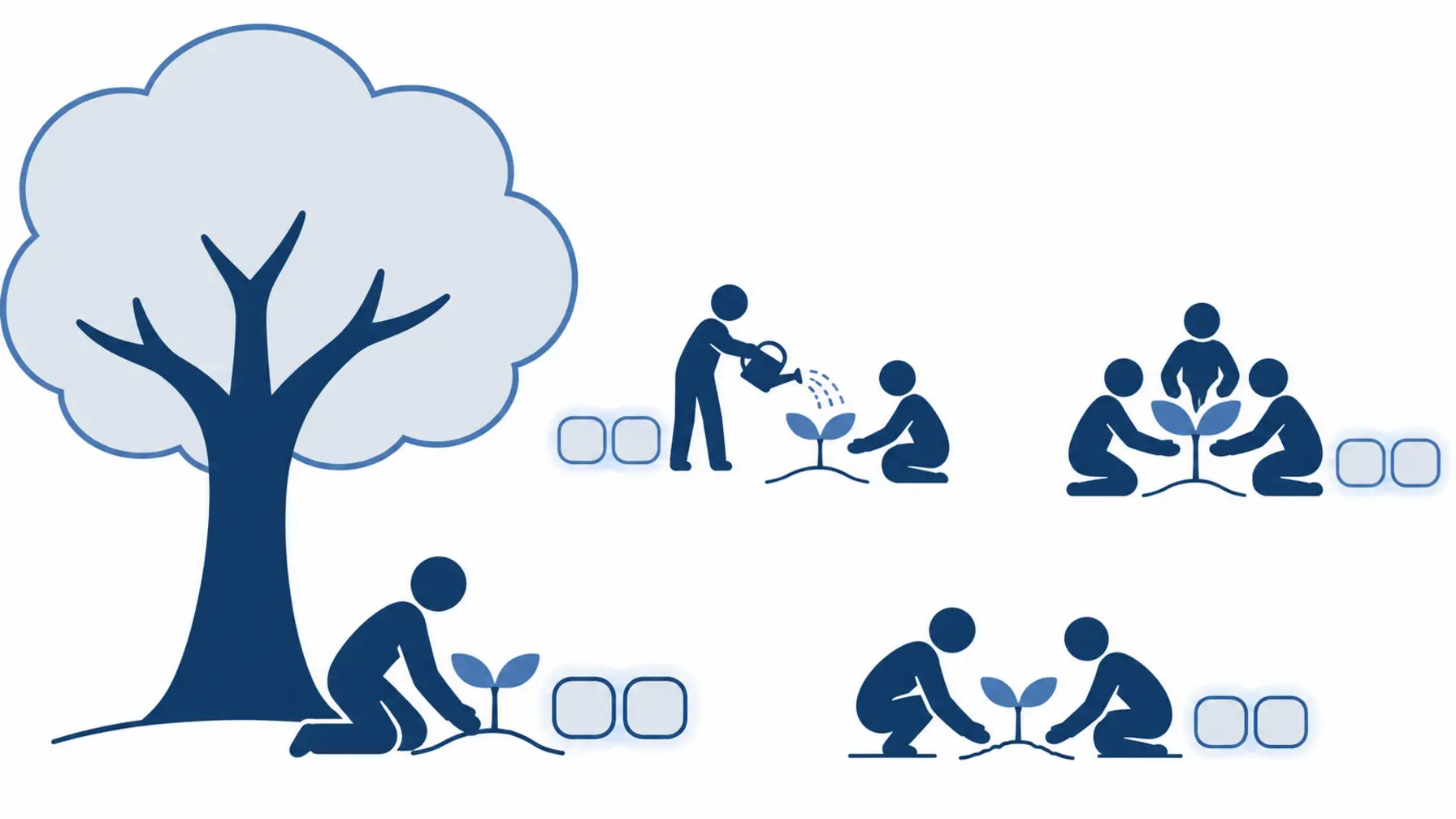
But there is another option: use the additional capacity to do things that were previously too expensive, too risky, or simply impossible with the available resources.
How many potential business opportunities have companies abandoned because they couldn't justify allocating an entire team to explore them? How many promising ideas never progressed beyond a conversation because testing them would have required months of development and a substantial investment?
AI could change that equation.
Imagine a small group of employees identifying a niche customer problem. Instead of requesting a dedicated development team and a significant budget, they could use AI-supported capabilities to explore the market, prototype a solution, conduct initial validation, and assess its potential.
The company would still need to provide resources and accept some risks. Customer acquisition, regulation, market demand, and commercial viability do not disappear because software becomes cheaper to develop.
But the cost of experimentation could decrease significantly, making more opportunities worth investigating.
This connects to the established concept of organizational ambidexterity, explored by Charles O'Reilly and Michael Tushman: an organization's ability to exploit its existing activities while simultaneously exploring new opportunities.
Historically, maintaining this balance has been difficult because exploration consumes resources that could otherwise support the core business. AI might reduce part of that tension by making experimentation less resource-intensive.
Perhaps a company could encourage small groups to explore new markets without dismantling the teams and relationships responsible for its existing success.
And perhaps employees would progressively develop a more entrepreneurial mindset, not because everyone must become an entrepreneur, but because they would gain the capacity to identify opportunities, propose initiatives, and participate more directly in creating business value.
Of course, not every experiment will succeed. Not every employee will want this responsibility. And not every company will have enough profitable opportunities to absorb all its productivity gains.
I don't want to pretend that AI-driven transformation can guarantee employment for everyone. It cannot.
But I do believe that reducing headcount should not automatically be considered the most intelligent way to capture the value created by AI. Preserving organizational knowledge and investing in growth may sometimes be a more valuable long-term choice.
Autonomy Changes the Role of Management
If people can form groups dynamically, explore opportunities, and execute work with much greater independence, traditional management practices will inevitably be challenged.
An organization cannot simply remove departmental boundaries and tell everyone to do whatever they want. Without shared objectives, transparency, and coordination, autonomy could quickly turn into fragmentation.
This creates questions that are not trivial. How do people identify opportunities aligned with company strategy? How do they find the right collaborators? How do they balance their existing commitments with new initiatives? Who decides when two promising projects compete for the same resources?
I find it particularly interesting that AI could support some of this coordination.
Imagine an internal AI system capable of connecting people around shared interests, identifying complementary expertise, highlighting duplicated efforts, or suggesting collaborations between initiatives.
It could make information more accessible and help people discover opportunities they would never have encountered within their traditional departments.
But information and authority are different things. An AI system recommending a collaboration is not the same as an AI system deciding how employees must organize themselves.
Personally, I lean toward preserving human participation in important organizational decisions. Not because collective decisions are always objectively better, but because having a voice in a decision can help people understand it, challenge it, and commit to its implementation.
The balance between autonomy, collective decision-making, and strategic leadership will depend on the organization, its culture, and its maturity. This question deserves its own discussion, because a more autonomous organization still needs a common direction.
An Organic Transformation, Not Another Reorganization
There is one principle I would strongly defend: I don't think companies should attempt this transformation through another massive, top-down organizational redesign.
We've seen enough organizational transformations where a theoretically attractive model becomes a rigid framework imposed on everyone, regardless of their needs or context.
I would rather start small.
Give a group of motivated people the freedom to experiment with AI-supported ways of working. Allow them to develop the necessary capabilities, build tools, discover limitations, and demonstrate actual results.
Measure outcomes, not simply the volume of work automated. Are they delivering more customer value? Can they validate new opportunities faster? Are they learning and sharing knowledge? Are they becoming more autonomous without creating new dependencies elsewhere?
Then allow successful practices to spread organically.
Some people will become particularly capable of designing and orchestrating AI-powered work systems. Others will retain stronger product, business, technical, or organizational expertise. Their collaboration will progressively shape new working arrangements.
The organization doesn't need to know exactly what its future structure will look like before beginning the transformation. It needs a clear direction, room for experimentation, and the ability to learn from what works.
In that sense, this evolution should be driven by the same principles I've always valued in Agile and Lean: understand the system, improve the flow of value, empower people, and adapt based on evidence rather than following a predefined organizational ideal.
Conclusion: The Future of Companies Might Be More Human Than We Expect
When we imagine an AI-powered company, we often picture an organization with very few employees and an enormous number of automated processes. Perhaps some companies will indeed evolve in that direction.
But I see another possibility.
I imagine companies where individuals are dramatically more capable thanks to AI, but where collaboration remains a fundamental source of value. Where people are no longer constrained by fixed professional boundaries, where groups form naturally around opportunities, and where the company's collective intelligence becomes more important, not less.
This is not a prediction. It's a vision worth exploring, with substantial questions still unanswered about coordination, organizational culture, economic viability, and governance.
And perhaps this evolution will eventually change the very meaning of a team. Not a permanent organizational unit defined by a manager or an HR chart, but a living network of people who continuously collaborate, learn, and create value together.
AI could make individuals extraordinarily powerful. But I believe the most interesting companies will be those that learn how to make their people extraordinarily powerful together.
The real question may not be how many employees AI allows us to replace, but how much more we could accomplish if we stopped organizing people around the limitations AI is progressively removing.
How this article was created: the ideas are mine, the words are ChatGPT's.
← Back to home